Unilevel Plan
One of the simplest compensation structures to explain to new distributors — unlimited frontline width with commission paid down a defined number of levels.
How it works
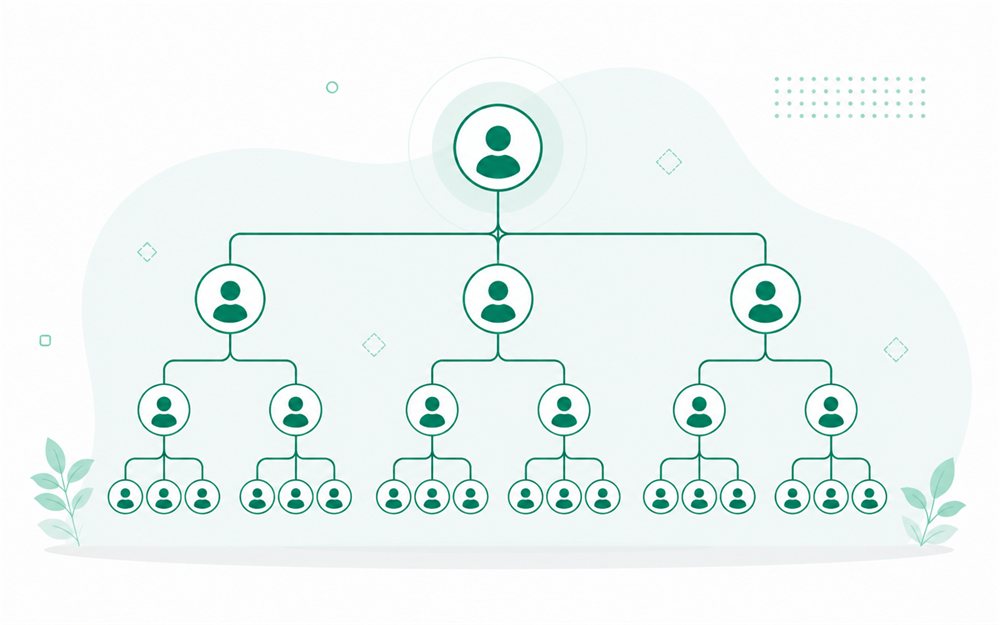
Every distributor can sponsor an unlimited number of people directly (unlimited "width"). Commission is then paid on sales generated by each level below a distributor, down to a fixed depth — commonly 5 to 10 levels, depending on your plan design.
- A distributor joins and can sponsor as many people as they want directly onto their own frontline — Level 1. There's no cap on width.
- Each Level 1 recruit can do the same. Their own frontline becomes Level 2 relative to the original distributor.
- This continues downward, level by level, entirely independent of anyone else's placement — nobody's recruits get placed under someone else without their own choice to sponsor them.
- When someone in the downline makes a qualifying purchase, commission is calculated and paid automatically up through however many levels the plan pays.
No spillover
Unlike Binary or Force Matrix plans, Unilevel has no spillover. Every person you personally recruit joins your own frontline — nobody else's overflow lands in your team, and none of yours lands in anyone else's. What you build is entirely a function of your own recruiting and how active your downline is, for better and worse: no help from an upline's excess recruits, but also no risk of your position being diluted by placements you didn't make.
A worked example
Say a distributor personally sponsors 4 people at Level 1, each of whom purchases RM1,000 in product. At a 10% Level 1 rate, that's RM400 in commission. If each of those 4 people goes on to sponsor 4 more — 16 people at Level 2 — and the Level 2 rate is 5%, that adds another RM800 (16 × RM1,000 × 5%). Level 3 might have 64 people at a lower rate again, and so on. Levels typically hold more people the deeper you go, which is exactly why the rate is usually stepped down at each level — to keep total payout sustainable as the team grows.
Typical bonus types
- Sponsor bonus — paid immediately when a direct recruit makes their first qualifying purchase.
- Fast start bonus — a time-limited bonus (commonly the first 30–60 days) for hitting a volume target early, aimed at giving new distributors quick momentum.
- Level commission — a percentage of sales at each depth level, usually decreasing further down the tree.
- Rank advancement bonus — a one-time or recurring bonus unlocked once a distributor's team hits a rank threshold.
- Leadership bonus — an ongoing override for distributors who actively mentor and support downline leaders, separate from straight level commission.
Pros and cons
Pros
- ✓Unlimited frontline width — no forced placement decisions to configure.
- ✓Simple to explain to new recruits compared to leg-based plans.
- ✓Rewards personal recruiting effort directly, not placement luck.
- ✓Straightforward for the back office to configure and audit.
Cons
- ✕Earnings depend heavily on how many people you personally recruit.
- ✕Deep-level commissions shrink fast if rates decline steeply.
- ✕No spillover means slower starters get no help from upline overflow.
- ✕Needs sensible level caps, or it can reward recruiting over actual sales.
How it compares to other plans
| Plan | Frontline width | Spillover | Best suited to |
|---|---|---|---|
| Unilevel | Unlimited | No | First-time, easy-to-explain plans |
| Binary | 2 legs | Yes | Fast, recruitment-driven growth |
| Force Matrix | Fixed (e.g. 3) | Yes | Bundled, low-cost entry packages |
| Breakaway | Unlimited | No | Leadership-heavy organisations |
Why companies choose it
Unilevel is straightforward to explain during recruitment ("build your team, earn from your team's sales") and doesn't require balancing two legs the way a binary plan does. It's a common starting plan for companies launching their first direct selling business.
What to configure
Depth of paid levels, commission percentage per level, minimum qualifying purchase amount, and any rank-based multipliers are all configured per your business rules — see the Admin Back-Office module for where these settings live. Want to see the numbers for your own rate schedule? Try the commission calculator.
Common questions about the Unilevel plan
No. Every person you personally recruit joins your own frontline. Nobody else's overflow lands in your team, and none of yours lands in anyone else's — unlike Binary or Force Matrix plans, which place excess recruits into other positions.
Most Unilevel plans pay between 5 and 10 levels deep, with the commission percentage usually decreasing at each level down. The exact depth and rate schedule is a business decision, not a technical limit.
Unilevel allows unlimited frontline width with no spillover, so your team is built entirely from your own recruiting. Binary limits you to two legs but adds spillover, meaning excess recruits from your upline can be placed in your team.
Yes, and most plans do exactly this — a higher rate at Level 1 that steps down at each level deeper, which keeps total payout sustainable as the number of people at each level grows.
It's one of the more common starting points because it's straightforward to explain to new distributors and doesn't require configuring leg-balancing or spillover rules — though it can encourage a strong recruiting focus if not paired with real product sales requirements.
Common additions are a sponsor bonus for direct recruits, a time-limited fast start bonus for new distributors, a rank advancement bonus, and a leadership bonus for mentoring downline leaders.
See it configured for your compensation plan
We'll walk you through how this fits with the rest of the platform.
Get in Touch